Home solar, battery backup, and EV charging guidance for practical residential energy decisions. Start a home energy review
Residential rooftop solar and battery installation
Home solar guidance

Sunnova helps families plan solar, storage, and EV charging with less guesswork

Compare solar panels, battery backup, inverter choices, and charging needs in one practical conversation. Sunnova keeps the language clear for homeowners while giving installers the details they need for a buildable system.

$
Enter a bill amount Estimate varies by roof, rate plan, equipment, incentives, and utility rules.
Common questions

What homeowners usually want to know first

Cost and financing

Look beyond the headline price. Sunnova reviews usable roof area, module class, inverter choice, battery option, monitoring, workmanship, utility interconnection, and eligible incentives before framing a practical cost range.

A lease or service plan can include storage when the project economics and local program allow it. Battery value depends on outage risk, time-of-use rates, and whether backup circuits are clearly defined.

Equipment choices

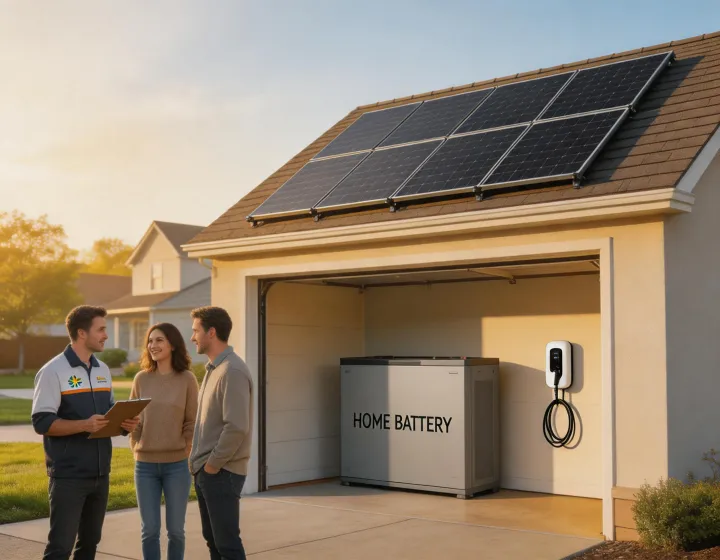
A battery is most useful when backup power, peak-rate shifting, or self-consumption matters. Sunnova sizes storage around critical loads, usable kWh, cycle life, and round-trip efficiency rather than a generic promise.

Level 2 charging can be planned with solar and battery storage. The review checks panel capacity, circuit location, charging schedule, and whether future vehicle-to-home readiness should be considered.

Service and support

Monitoring should show solar production, battery state of charge, grid import, export, alerts, and service history in plain terms so a homeowner knows when everything is operating normally.

Sunnova routes questions around billing, monitoring, warranty documentation, and service coordination so the homeowner is not left translating between hardware suppliers and installation teams.
Installer reviewing home solar monitoring dashboard
Guided decisions

One plan across solar panels, battery storage, EV charging, and monitoring

1

Bill-first sizing

Planning begins with utility usage, rate structure, and roof conditions so the solar panel recommendation fits a real household instead of a generic package.
2

Backup clarity

Battery conversations separate whole-home ambitions from critical-load backup, usable kWh, LFP chemistry, and expected cycles at 90% DoD.

3

EV-ready pathways

Charger placement, panel capacity, charging window, and future vehicle needs are considered before conduit and load-center decisions become expensive.

4

Service visibility

Monitoring, alerts, warranty terms, and support handoff stay visible after installation so homeowners know how the system is performing.

Planning references

Typical residential energy specification ranges

Solar panels

Module classBlack monocrystalline PV modules for residential roofs
Output range400 W to 450 W per module, roof-dependent
Warranty framing25-year linear power warranty where supported by equipment supplier terms

Battery backup

ChemistryLFP or equivalent residential storage chemistry by approved product line
Usable capacityDesigned around critical loads, outage goals, and daily cycling assumptions
Safety referencesUL 9540A, UL 1973, and local code review where applicable

Inverter and EV charging

Inverter roleString inverter or microinverter architecture selected by roof layout and shading
EV chargerLevel 2 charging plan coordinated with service panel capacity
Homeowner voices

Clear explanations make better energy projects

"The review helped us understand which loads our battery would actually cover during an outage."

Maria P. · Homeowner

"Instead of pushing one package, Sunnova compared solar, storage, and charger timing around our utility bill."

Kevin R. · EV owner

"The installer notes were specific enough for permitting, wiring, and a clean customer handoff."

Danielle S. · Solar installer
Get a practical review

Share your bill, roof notes, and backup goals

Sunnova will help organize the early questions before equipment selection, financing comparison, and installer coordination begin.

Please share your name.
Please enter a valid email.
Please accept the privacy policy.

If you keep comparing solar quotes alone

Panel wattage, lease terms, battery backup claims, EV charger readiness, and monitoring language can start to sound similar even when the designs are not equivalent.

With Sunnova, the questions get organized

We turn your utility bill, roof constraints, outage priorities, and charging habits into a structured review that helps you decide what belongs in the project.

Plan My Review